
Calorie Deficit Calculator: Find Your Number
Calculate your exact calorie deficit with the Mifflin-St Jeor formula. Includes TDEE activity multipliers, worked examples, and how to adjust over time.
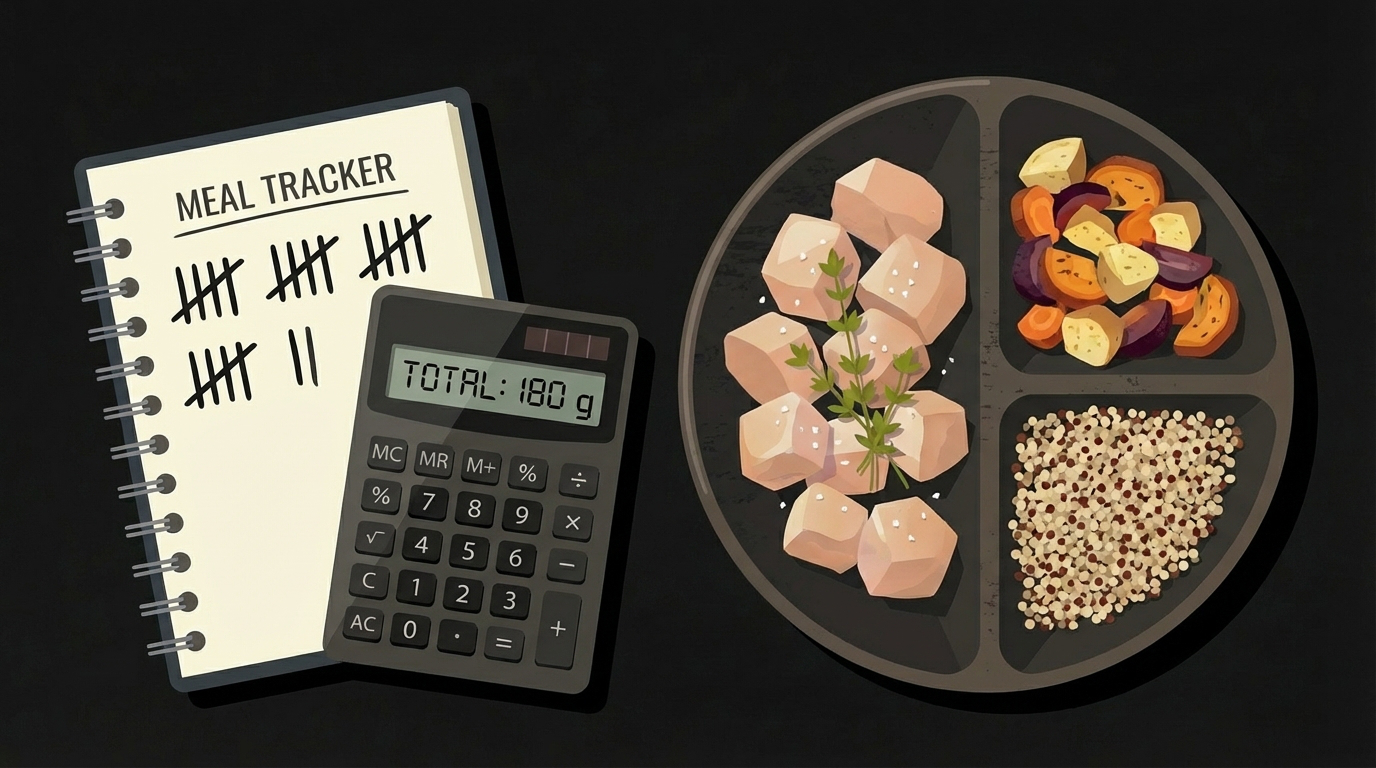
Most people who try calorie counting quit within two weeks. Not because the math is hard, but because they picked the wrong number. Too aggressive and you're white-knuckling through hunger. Too conservative and the scale doesn't budge.
A calorie deficit calculator fixes that. Plug in your stats, get a personalized target, and start there. You can try our free TDEE calculator right now, or keep reading to understand the formula behind it and learn how to stick with your deficit long enough to see real results.
How a Calorie Deficit Works
Weight loss comes down to one principle: eat fewer calories than your body burns. The difference between what you burn and what you eat is your calorie deficit.
Your body burns calories in three ways:
- Basal Metabolic Rate (BMR): The calories your body needs just to stay alive. Breathing, circulation, cell repair. This accounts for 60-70% of your total burn.
- Thermic Effect of Food (TEF): The energy it takes to digest what you eat. Roughly 10% of your intake.
- Physical Activity: Everything from walking to the gym. This is the most variable component and the one most people overestimate.
Add those three together and you get your Total Daily Energy Expenditure (TDEE), the total number of calories you burn in a day. Eat below your TDEE and you lose weight. Eat above it and you gain.
How to Calculate Your Calorie Deficit (Step by Step)
Several equations estimate BMR, but the Mifflin-St Jeor equation is the most accurate for most people. A systematic review published in the Journal of the American Dietetic Association found it predicts BMR within 10% of measured values in 82% of non-obese individuals.
Here's the formula:
For men: BMR = (10 × weight in kg) + (6.25 × height in cm) - (5 × age in years) + 5
For women: BMR = (10 × weight in kg) + (6.25 × height in cm) - (5 × age in years) - 161
A Quick Example
A 30-year-old man who weighs 85 kg and is 180 cm tall:
BMR = (10 × 85) + (6.25 × 180) - (5 × 30) + 5 = 850 + 1,125 - 150 + 5 = 1,830 calories/day
That's what his body burns at complete rest. But nobody lies in bed all day (hopefully), so the next step is accounting for activity.
TDEE Activity Multipliers
Multiply your BMR by one of these factors to estimate your TDEE:
| Activity Level | Description | Multiplier | Example TDEE (BMR 1,830) |
|---|---|---|---|
| Sedentary | Desk job, little exercise | 1.2 | 2,196 |
| Lightly active | Light exercise 1-3 days/week | 1.375 | 2,516 |
| Moderately active | Moderate exercise 3-5 days/week | 1.55 | 2,837 |
| Very active | Hard exercise 6-7 days/week | 1.725 | 3,157 |
| Extremely active | Athlete or physical labor job | 1.9 | 3,477 |
The most common mistake here is overestimating your activity level. Walking to the office and doing three gym sessions a week? That's "lightly active," not "moderately active." Be honest with yourself. If your first estimate doesn't produce results after two weeks, you probably picked too high.
What Size Calorie Deficit Do You Need?
Once you know your TDEE, subtract calories to create your deficit. Here's how different deficit sizes compare:
| Deficit | Weekly Loss | Best For | Risk Level |
|---|---|---|---|
| 250 cal/day | ~0.5 lb/week | Lean individuals, slow and steady | Low |
| 500 cal/day | ~1 lb/week | Most people, balanced approach | Low |
| 750 cal/day | ~1.5 lb/week | Higher starting weight | Moderate |
| 1,000 cal/day | ~2 lb/week | Obese individuals (with guidance) | Higher |
For most people, a 300-500 calorie daily deficit is the sweet spot. It's large enough to see real progress (1 lb/week adds up to 50+ lbs in a year) but small enough that you won't feel deprived, lose muscle, or crash your metabolism.
Minimum Calorie Floors
No matter how aggressive your deficit, don't go below these minimums without medical supervision:
- Women: 1,200-1,500 calories/day
- Men: 1,500-1,800 calories/day
Below these thresholds, it becomes difficult to get adequate nutrition. You'll lose muscle, your energy will tank, and your body will fight back with increased hunger hormones.
Calorie Deficit Calculator: Two Real Examples
Let's walk through the full calculation for two different people.
Person A: Sarah, 28, 70 kg, 165 cm, lightly active
- BMR: (10 × 70) + (6.25 × 165) - (5 × 28) - 161 = 700 + 1,031 - 140 - 161 = 1,430 cal
- TDEE: 1,430 × 1.375 = 1,966 cal
- Deficit (500 cal): 1,966 - 500 = 1,466 cal/day
That's tight. Sarah could go with a smaller 300-calorie deficit instead (1,666 cal/day) and still lose about 0.6 lb per week. Slower, but much more sustainable and well above the minimum floor.
Person B: James, 35, 100 kg, 183 cm, moderately active
- BMR: (10 × 100) + (6.25 × 183) - (5 × 35) + 5 = 1,000 + 1,144 - 175 + 5 = 1,974 cal
- TDEE: 1,974 × 1.55 = 3,060 cal
- Deficit (500 cal): 3,060 - 500 = 2,560 cal/day
James has plenty of room. He could even go to a 750-calorie deficit (2,310 cal/day) and still eat comfortably.
The pattern is clear: the more you weigh and the more active you are, the more room you have to create a deficit without suffering.
Why Your Number Is a Starting Point (Not Gospel)
Every calorie deficit calculator is an estimate. The Mifflin-St Jeor equation is the best available, but it can still be off by 10-15% in either direction. Your actual metabolism depends on factors no equation captures: genetics, hormones, sleep quality, stress, and more.
Treat the calculator as your starting line, then adjust based on what actually happens:
- Losing 0.5-1 lb/week? You're in the zone. Keep going.
- Losing more than 2 lb/week (after the first two weeks)? You're too aggressive. Add 200-300 calories.
- Weight hasn't budged in 2-3 weeks? Drop another 100-200 calories or increase activity.
- Feeling exhausted, irritable, or constantly hungry? Your deficit is too large. Eat more.
Weigh yourself daily and track the weekly average. Daily weight fluctuates by 1-3 lbs from water, sodium, and digestion. The weekly trend is what matters. If you only weigh once a week, you might catch a high day and think nothing is working when you've actually lost fat.
5 Calorie Deficit Mistakes That Kill Your Progress
1. Eating Back Exercise Calories
Your fitness tracker says you burned 500 calories on the treadmill. So you eat 500 extra calories. Problem: exercise calorie estimates are notoriously inaccurate (often inflated by 20-50%). Your TDEE already accounts for your general activity level. Don't add exercise calories back on top.
2. Forgetting Liquid Calories
A splash of oat milk in your coffee, a glass of wine with dinner, a smoothie as a "snack." Liquid calories don't trigger satiety the way solid food does, but they count just the same. A daily latte with oat milk and a glass of wine adds roughly 300 calories that many people never log.
3. Eyeballing Portions
Studies show people underestimate portions by 20-50%. That "tablespoon" of peanut butter you eyeballed? Probably closer to two tablespoons, which is an extra 90 calories. A food scale costs $10 and eliminates guesswork. Use one at home, at least for the first few weeks until you calibrate your eye.
4. Weekend Amnesia
Five days of disciplined eating erased by two days of "I'll start again Monday." A 500 cal/day deficit Monday through Friday (2,500 total) can be wiped out by two restaurant meals over the weekend. Your deficit is a weekly average, not a weekday plan.
5. Setting the Deficit Too Aggressively
Dropping to 1,200 calories when your TDEE is 2,500 feels productive on Day 1. By Day 10, you're exhausted, bingeing on peanut butter at midnight, and convinced calorie counting doesn't work. A moderate deficit you can sustain for six months beats an aggressive one you abandon in two weeks.
How to Stick to Your Calorie Deficit
Track consistently, not perfectly. You don't need to weigh every grain of rice. But you do need to log every day, including the bad days. Consistency in tracking matters more than precision. In Mealchat, you can describe a meal like "roughly two handfuls of pasta with meat sauce and parmesan" and get a reasonable estimate in seconds. That's infinitely better than not logging at all because you didn't have a food scale. If your current tracker makes logging feel like homework, it might be the app, not you — we compared the best MyFitnessPal alternatives to help you find one that fits.
Front-load protein. Protein is the most satiating macronutrient. Aiming for 1.6-2.2g per kg of body weight helps preserve muscle during a deficit and keeps you feeling full. A 70 kg person should target roughly 112-154g of protein daily. Build meals around protein first, then fill in carbs and fats. If you need ideas, chicken breast is one of the most efficient protein sources at 165 calories and 31g protein per 100g cooked.
Plan for the meals that trip you up. For most people, that's dinner and late-night snacking. If you know you tend to overeat at night, eat a lighter breakfast and save more calories for the evening. There's no metabolic advantage to eating small meals throughout the day. Distribute your calories in whatever pattern makes the deficit easiest to maintain.
Recalculate every 5-10 lbs lost. As you lose weight, your TDEE drops. The deficit that worked at 90 kg won't work at 80 kg because your body is burning fewer calories at the lower weight. Run your new numbers through our TDEE calculator, adjust, and keep going.
The Bottom Line
A calorie deficit calculator gives you a starting point: take your BMR (via the Mifflin-St Jeor equation), multiply by your activity level to get your TDEE, and subtract 300-500 calories. For most people, that lands somewhere between 1,500 and 2,500 calories per day. If you haven't already, calculate your TDEE now.
But the number is just the beginning. The real skill is treating it as a living target that you adjust based on real-world results. Weigh yourself daily, track the weekly average, be honest about your activity level, and recalculate as your weight changes.
A moderate deficit, tracked consistently, beats a perfect plan you can't follow.