
10 Calorie Counting Mistakes Sabotaging You
Most people underreport calories by 20-50%. These 10 common calorie counting mistakes explain why, and each one comes with a concrete fix.
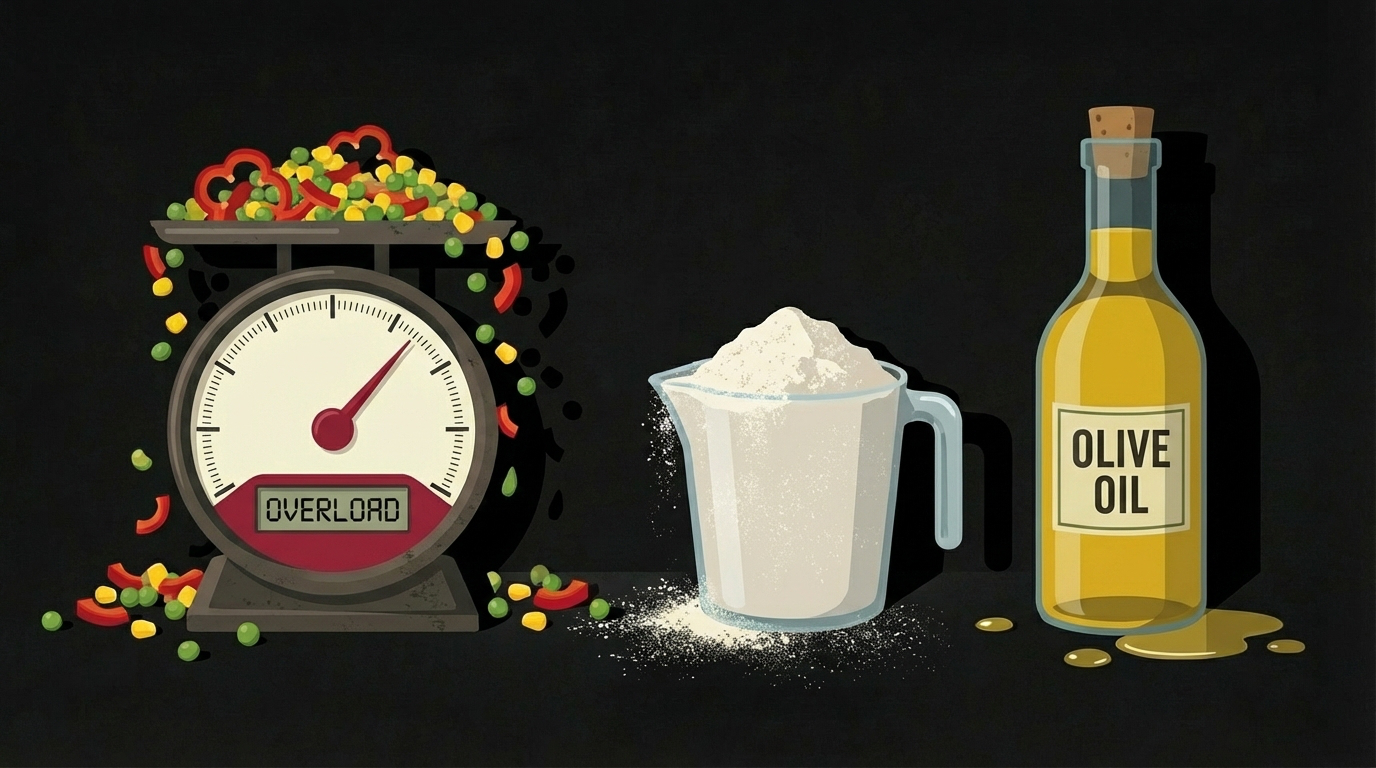
You track every meal. You hit your calorie target on paper. The scale won't budge. What gives?
A 1992 study in the New England Journal of Medicine found the answer: people underreport their calorie intake by an average of 47%. Even trained dietitians underestimate calories in meals by approximately 30%. The calories you think you're eating and the calories you're actually eating are probably two very different numbers.
The 10 most common calorie counting mistakes are: eyeballing portions, forgetting cooking oils, skipping liquid calories, mixing up raw and cooked weights, only tracking weekdays, trusting inaccurate database entries, ignoring metabolic adaptation, eating back exercise calories, cutting too aggressively, and fixating on daily totals instead of weekly trends. Together, these errors can add 300-500 untracked calories per day.
Here's each one in detail, ranked by impact, with a concrete fix.
1. Eyeballing Portions Instead of Weighing
This is the single biggest source of tracking error. Studies show people underestimate portion sizes by 20-50%, depending on the food. One study found estimates ranged from 43% under for condiments to 156% over for pasta.
The problem compounds over the day. Underestimate your morning oats by 20%, your lunch chicken by 15%, and your dinner rice by 30%, and you've added 300-500 invisible calories.
The fix: Use a food scale for calorie-dense foods. You don't need to weigh lettuce, but anything with meaningful calories per gram (rice, pasta, meat, nuts, cheese, oils) should go on a scale. A basic kitchen scale costs under $15 and takes five seconds to use.
If you hate the scale: Use the hand-portion method as a floor. Your palm is roughly one protein serving (about 120g cooked meat). Your cupped hand is roughly one carb serving. Your thumb tip is about one tablespoon of fat. It's not perfect, but it's far better than guessing.
2. Forgetting Cooking Oils and Fats
A single tablespoon of olive oil contains 119 calories. A tablespoon of butter is 102. Most people pour oil from the bottle without measuring, and a casual "glug" easily adds 2-3 tablespoons.
Do the math: 3 tablespoons of olive oil across your day's cooking is 357 calories, roughly the equivalent of an entire extra meal, and most people never log a single drop.
| Fat Source | Calories per Tablespoon | Common Untracked Amount | Hidden Calories |
|---|---|---|---|
| Olive oil | 119 | 2 tbsp (cooking dinner) | 238 |
| Butter | 102 | 1.5 tbsp (toast + cooking) | 153 |
| Coconut oil | 121 | 1 tbsp (cooking) | 121 |
| Mayo | 94 | 2 tbsp (sandwich + salad) | 188 |
| Ranch dressing | 73 | 3 tbsp (salad) | 219 |
The fix: Measure your cooking oil with a tablespoon or weigh it (1 tbsp of oil weighs about 13-14g). If you're cooking for multiple people, measure the total oil used, divide by servings, and log your share. In Mealchat, you can log something like "stir fry with 1 tbsp sesame oil" and it accounts for the oil in the total macro breakdown automatically.
3. Skipping Liquid Calories
That morning latte with whole milk? 190 calories. Two glasses of wine at dinner? 250 calories. A bottle of orange juice? 220 calories. Weekend beers? 150-200 each.
Liquid calories are uniquely deceptive because they don't feel like food. Your brain doesn't register them the way it registers solid meals, so you forget to log them, and they don't reduce your appetite for the next meal.
The fix: Log every drink that isn't water, black coffee, or plain tea. Pay special attention to:
- Coffee additions: Cream, sugar, flavored syrups. A "splash" of cream is usually 2-3 tablespoons (70-100 calories).
- Alcohol: Beer averages 150 cal, wine 125 cal per glass, cocktails 200-500 cal depending on mixers.
- Smoothies and juices: Often 300-500 calories, sometimes more than the meal they replace.
- Protein shakes: Usually 150-300 calories. Easy to forget because they feel like supplements, not food.
4. Mixing Up Raw and Cooked Weight Entries
A raw chicken breast weighing 200g loses about 25% of its weight during cooking, ending up around 150g cooked. If you weigh 200g of raw chicken but select a "cooked chicken breast" database entry, you've just overestimated your protein and calories by roughly 25%.
The reverse is worse. Weigh your cooked chicken at 150g but log it under a raw entry, and you've underestimated. Cooked chicken is more calorie-dense per gram because the water evaporated but the nutrients stayed.
The fix: Pick one approach and stick with it. Weigh raw, log raw. Weigh cooked, log cooked. Most serious trackers prefer weighing raw because it's more consistent (cooking methods affect final weight differently each time). If you need a refresher on how much this matters, see our breakdown of chicken breast calories by preparation method.
5. Only Tracking Weekdays
Monday through Thursday, your log is meticulous. Friday dinner out? Not logged. Saturday brunch? "Cheat day." Sunday barbecue? "I'll start fresh Monday."
Those 3 untracked days often contain your highest-calorie meals. A restaurant dinner can hit 1,200-1,500 calories. Brunch with mimosas? Easily 1,000. If your weekly deficit requires 2,000 calories per day but three untracked days average 2,800, your actual weekly average is 2,343. Your deficit has nearly vanished.
The fix: Track every day, even imperfectly. A rough estimate on Saturday is infinitely better than a blank entry. You don't need precision on social days. "Two slices of pepperoni pizza, a beer, and a slice of cake" logged approximately is close enough to keep your weekly picture accurate.
6. Trusting User-Generated Database Entries
Open any major calorie tracking app, search "banana," and you'll find entries ranging from 89 to 135 calories. Some entries were submitted by users who weighed a small banana with the peel. Others used a large banana without it. Some are simply wrong.
Approximately 1 in 5 community-submitted food database entries contain errors exceeding 20%, according to a 2024 analysis. When you pick the wrong entry, that error repeats every time you log that food.
The fix: Cross-check suspicious entries against the USDA FoodData Central database, which is the gold standard for nutritional accuracy. For packaged foods, always use the barcode scanner or manually enter data from the nutrition label rather than searching generic terms. When a database entry seems too good to be true ("pizza, 150 calories"), it probably is.
7. Not Adjusting for Metabolic Adaptation
You calculated your calorie deficit three months ago and have been eating 1,800 calories since. But you've lost 7kg, and the scale has stalled.
Here's what happened: as you lose weight, your body burns fewer calories. Your BMR drops because there's less of you to maintain. Your NEAT (non-exercise activity thermogenesis) often drops unconsciously: you fidget less, take fewer steps, move more slowly. Metabolic adaptation can reduce TDEE by 10-15% beyond what weight loss alone would predict, according to published research on adaptive thermogenesis.
The fix: Recalculate your TDEE every 4-6 weeks or after every 3-5kg of weight loss. If you started at a 500-calorie deficit and have lost significant weight, that same calorie target might now be at maintenance. The math changes as you change, and your tracking needs to keep up.
8. Eating Back Exercise Calories
Your fitness tracker says you burned 600 calories on a 45-minute run, so you eat an extra 600 calories. Except wearable devices overestimate calorie burn by 27-93%, according to a Stanford University study. That "600-calorie" run likely burned 350-450, and some of those were calories you'd have burned sitting at your desk anyway.
The fix: If you want to account for exercise, eat back no more than half of what your tracker reports. Better yet, set your calorie target based on your general activity level (including regular exercise) and don't adjust day-to-day for individual workouts. This smooths out the inherent inaccuracy in exercise calorie estimates.
9. Cutting Calories Too Aggressively
Eating 1,200 calories because a calculator told you to? A deficit that large triggers survival responses: hunger hormones spike (ghrelin rises 20-30%), metabolic rate drops, muscle breaks down, and binge eating eventually wipes out weeks of restriction.
The result: the yo-yo pattern. Extreme restriction followed by overeating, averaging out to zero net loss over months while you feel terrible the entire time.
| Deficit Size | Weekly Loss | Sustainability | Muscle Preservation |
|---|---|---|---|
| 250 cal/day (small) | ~0.2 kg | Very high | Excellent |
| 500 cal/day (moderate) | ~0.45 kg | High | Good |
| 750 cal/day (aggressive) | ~0.7 kg | Moderate | Fair |
| 1,000+ cal/day (extreme) | ~0.9+ kg | Low | Poor |
The fix: Aim for a moderate deficit of 300-500 calories below your TDEE. Yes, it's slower. But a moderate deficit you can sustain for 6 months will always beat an extreme deficit you abandon after 3 weeks. For most people, this means eating no less than your body weight in pounds multiplied by 10-12 as a calorie floor.
10. Fixating on Daily Totals, Not Weekly Trends
You ate 2,300 calories yesterday when your target was 2,000. Panic. You restrict to 1,500 today to compensate. Tomorrow you're starving and eat 2,600. This daily overcorrection creates a chaotic pattern that tanks both adherence and accuracy.
The fix: Think in weekly averages. Your body doesn't reset at midnight. If your weekly target is 14,000 calories (2,000/day), it doesn't matter much if one day is 2,400 and another is 1,600, as long as the week averages out. Track daily, but evaluate weekly. A rolling 7-day average of your weight and your intake gives you a far more useful signal than any single day.
How 500 Phantom Calories Sneak Into a "Perfect" Day
Here's what a typical day of invisible calorie errors looks like:
| Mistake | Hidden Calories |
|---|---|
| Eyeballed oatmeal (extra 30g) | +50 |
| Untracked cooking oil (1.5 tbsp) | +179 |
| Coffee with cream (not logged) | +70 |
| "Cooked" entry for raw chicken weight | +40 |
| Handful of nuts while cooking | +95 |
| Salad dressing underestimated | +60 |
| Total untracked | +494 |
That's nearly 500 invisible calories, enough to completely erase a standard calorie deficit. And this is a conservative estimate for someone who thinks they're tracking carefully.
How Accurate Do You Actually Need to Be?
Here's the counterintuitive truth: you don't need perfect tracking to lose weight. Research shows that even imprecise calorie tracking (within 20-30% error) produces significant weight loss compared to no tracking at all. Paying attention to food naturally moderates how much you eat.
The goal isn't logging every molecule. It's eliminating the systematic errors above, the ones that consistently push your count in one direction (almost always under). Fix the big three (cooking oil, portions, weekends) and you'll close the gap between your food log and reality.
In Mealchat, you can describe meals with as much or as little detail as you want. "200g chicken breast grilled in 1 tsp olive oil with 150g rice" captures the cooking oil automatically. "Chicken and rice for lunch" gives you a reasonable estimate when precision isn't practical. The key is that something gets logged, every meal, every day.
Frequently Asked Questions
Why is my calorie counting not working?
The most likely reason is underreporting. Research shows people underestimate calorie intake by 20-47% on average. The biggest culprits are eyeballed portions, untracked cooking oils (one tablespoon of olive oil is 119 calories), skipped weekend logging, and inaccurate database entries. Fixing these systematic errors typically closes the gap between your food log and actual intake.
How many calories can you miss by not tracking cooking oil?
A single tablespoon of any cooking oil contains approximately 120 calories. Most people use 2-3 tablespoons per day without measuring, which adds 240-360 untracked calories. That alone is enough to erase a moderate calorie deficit.
Should I weigh food raw or cooked for calorie counting?
Either works, but you must be consistent. Weigh raw and log a raw entry, or weigh cooked and log a cooked entry. Mixing them up creates a 20-25% error because food loses water weight during cooking. Most experienced trackers prefer weighing raw for consistency, since cooking methods affect final weight unpredictably.
How accurate does calorie counting need to be to lose weight?
You don't need perfect accuracy. Studies show that even imprecise tracking (within 20-30% error) produces significant weight loss compared to no tracking. The key is eliminating systematic underreporting rather than chasing exact numbers. Consistently logging every meal, even with rough estimates, beats precise tracking five days a week with blank weekends.
Should I eat back calories burned during exercise?
No, or at most eat back half. Wearable fitness trackers overestimate calorie burn by 27-93% according to a Stanford University study. A better approach is to set your daily calorie target based on your overall activity level and not adjust for individual workouts.
The Bottom Line
Calorie counting works, but only if your numbers reflect reality. The most common mistakes aren't about willpower or discipline. They're about invisible calories: cooking oil you didn't measure, portions you eyeballed, weekends you skipped, and database entries you trusted blindly.
Start with the biggest lever. For most people, that's mistake #1 (eyeballing portions) or #2 (cooking oils). Fix one per week, not all ten at once, and you'll close the gap between your food log and your actual intake. That's when the scale starts moving again.